'It is better to light a candle than curse the darkness' Proverb
Showing posts with label My work. Show all posts

Sunday, 28 May 2023

Why I Work Outside


It would be true to say that there are many pluses to working indoors.  It's usually dry and warm, and there's usually an endless supply of tea.  Unfortunately that isn't really enough for me.  I can deal with the wind and rain (and the lack of tea) much more than I can deal with the lack of natural light, only hearing human noises, and just sitting still all day long.  Working outside works best for me and here's why:

Constant Exercise


It's true to say that this is generally good for everyone, but for me and the way my body works, with PCOS, it's best when I'm constantly moving.  This constant movement allows me to be healthy and to keep the excess weight off.  Most of the time the work I do outside is very physically and basically like carrying out a gym section all day long.  I genuinely enjoy it and it does seem to be what is healthiest for me.  It's certainly what has allowed me to keep to a healthier weight these last few years.

Helping with the Hyper


I can get very hyper, and I mean hyper.  If I don't get most of my energy out during the day then my energy levels peak at around 9 or 10 pm (I'm naturally a night owl) and then my poor husband has to deal with what is essentially a manic cat.  Working in an office really didn't help with this, and construction work only slightly, but being active in nature all day helps me release quite a bit of this energy.  This means that my husband only has to deal with a slightly manic cat when he's starting to get sleepy.

Helping with Sleep


Speaking of sleep.  My natural state seems to be to not sleep very well, my brain just has trouble shutting down.  This got worse whilst I was working in offices.  Not only was I not exhausting my body, but not matter how hard I worked it actually seems to switch my brain on even more.  When I work outside not only do I physically exhaust my body, but it also seems to exhaust my brain too so it takes a lot less time to switch off.  I also find that being in natural light all day long helps keep my natural body clock in check so that I don't become too much of a night owl, and that helps with me fall asleep earlier than I might do naturally.

Mental Health


This is probably the biggest, and for me the most important, reasons for working out doors.  Being outside all day long has had a definite positive impact on my mental health.  This isn't going to be the case for everyone, especially when it's wet and grey outside, but to me it makes all the difference.  I feel better just by being surrounded by greenery, animal sounds, and a lack of people.  Having this as my work week has meant that I have felt generally much better all round.  Do I never get depressed now, unfortunately that's not the case, but it does happen less and I am able to deal with it a lot better, and that's a win as far as I'm concerned.

It Just Feels Natural


When it comes to work I'm happiest when my brain and body are working together.  Working in the office meant that I only got to use my brain, but outdoor work means I get to use both now and that just feels natural to me.  The final thing is that I just love being outdoors.  Even if none of the other things were true I would still be happier outdoors in the rain than indoors in the dry.  It just feels like that's where I'm naturally meant to be.


Now that I've had the opportunity to work outdoors I don't think I could ever go back to working completely indoors again.  Hopefully I'll be able to keep on mostly working outdoors now until the end of my working career.  What that career journey will look like in the future I don't know, but I will keep it mostly outdoors as much as I can and then I'll be able to carry on getting all the benefits I get right now.

Sunday, 1 September 2019

Path Work - August (Glencoe)


To say that August has been a wet month is probably a big understatement, we've rarely had a day that it hasn't rained on us.  We have had some beautifully sunny days, but we've also had some absolute down pours, usually when we're already at the site pretty high up the path.  Still on the Coire nan Lochan path, the two sites we've been working on in August have been at the bedrock at the top of the path where it begins to disappear and half way down the path at one of the scree sites.


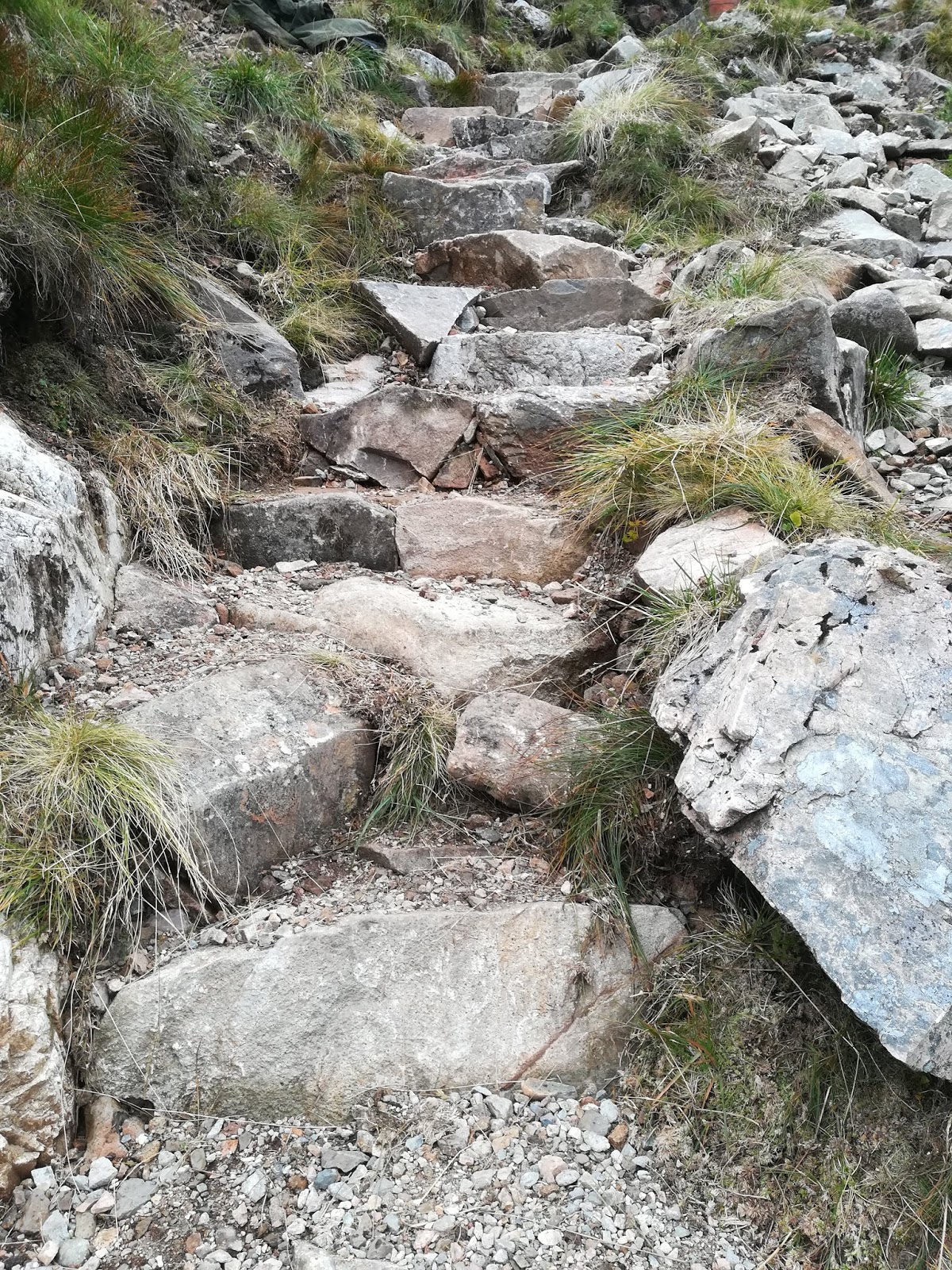
To begin with we finished off the stone pitching we had been adding onto of the bedrock to help make it a lot more accessible and easier to walk on, taking people away from the sides which are much more difficult to navigate than they look.  


We then carried on the stone pitching above this slab of bedrock where the water running down the hill had produced a large, slippery gully, fitting the stones in between the bedrock and tufts of vegetation that was left.  


Here a lot more work was needed than we had initially thought, including a revetment, but thankfully we were able to find the amount of stones we actually needed to complete the work.  


As a rule of thumb you always need a lot more stones (and I mean A LOT more) than you might think for stone pitching. 


Due to the amount and speed of the water that flows down this section we decided to add a double water bar at the top of the stone pitching to help move as much of this as possible off path.  Later my work colleague added a very large ditch to help catch an amazingly large amount of water from the side of the hill and channel it through this water bar into the gully below. 


And then there was more stone pitching to a section that was also just another deep, slippery gully.  This took us over the last bit of bedrock we were needing to work on and onto the much flatter final section.  It's interesting watching people now walk over this section of path.  Before it was more of a scramble, with people often having to use their hands to help get up over the top.  Now they walk up with relative ease, though the path is still pretty steep and unfortunately we can't really do anything about that. 


Once the bedrock section was finished, including packing, landscaping, and adding surfacing, we moved onto the last upper section of the path.  A couple of step rises were added just below a water bar that was already there from previous work to help hold the surfacing in place and then we needed to work on this original bar.  


The ditching on either side had become overgrown and was no longer properly channelling water both to and from the bar.  This meant that is was just flowing back onto the path.  The ditching on both sides was re-dug and made much larger, hopefully increase the amount of time before it became overgrown again, and we did get to see our handy work on a very rainy day.  There's a lot of water now being caught by those ditches and not now heading down the path - always satisfying.


Before
After
After
The water bar was then turned into a double water bar to help hold the surfacing back, reducing the chance of the bar become clogged again (especially as it took us a while to find the original liners after quite a bit of digging).  A small revetment on the hill side attached to the water bar meant that we could channel water coming from an upper section of peat into the water bar as well.  


Then it was more step rises and stone pitching until we came to the point where the path began to disappear and people are able to make their own way to the upper paths.  This was probably the most satisfying section to build as we were needing to find very specific and unusually shaped stones to fit the space we had.  It's always good when they all fit together, like they were meant to be, and look like a natural part of the rocks surrounding them.  Many probably won't even realise that these stones have been added.


Finally we added a revetment with a large end stone to help navigate the water off this section of path and into a gully which led to the original water bar we had already been working on.


And then we started heading back down the path, carrying out final bits of landscaping and tidying as we went.  I also added what is probably the worst made cairn ever (note to self - definitely need practise on this) to help navigate people up the bedrock at one of the easiest routes.  Thankfully a work colleague redid the cairn and it's now much better - the photo is of my one so I wouldn't judge it on that.


Back down the path we are back at one of the previous scree sites which has already been showing signs of damage from the sheer amount of water we've had falling here recently.   The large amount of rain had led to channels forming on the path, removing surfacing from some of the step rises we had placed and increasing the size of the gully in the path just down from this area.  


The first thing we did was move some more larger stones down to the path to hold back more of the scree on the hill side which was being washed onto the path.  


Then a double water bar was added just above the previously built step rises, made relatively deep to catch the amount of water travelling at this point.


Finally, now that we had channelled most of the water off the path, we added some step rises to the section just below the scree site where the gully was forming.  This was to raise the path again and to help hold the surfacing in place, reducing any future erosion.  


Because this gully had also begun to undermine a revetment previously built on the hill side we also had to add another row of stones below the previous ground level section to hold it all in place.  As with all of the built features, this section needed to be packed, landscaped and surfacing added.


Not a bad months worth of work when you add in the fact that we had quite a few days of high winds and heavy rain battering against us.  A couple of times the wind has been so strong it's made it difficult just to stand up let alone get some actual work done.  But then it wouldn't be Scotland, and certainly not Glencoe, if you didn't get some really bad weather followed by some glorious periods of warm sun which you enjoy, suspicious of what's coming next.

Sunday, 14 April 2019

Path Work - March (Balmoral Estate)


March saw me working back in the Cairngorms National Park, this time on a path on the Balmoral Estate.  It has definitely been an interesting month weather wise, with some hot days and clear skies feeling almost like a Scottish summer to so much snow and wind we weren't even able to actually get to the work site.


Our location was a path that meanders through the Ballochbuie Forest on the north west side of the Estate.  This seems quite an underused path (I think we saw one person on the path that month) which is a real shame as it's a beautiful walk through one of the largest remaining Caledonian Forest.  You just don't get to walk through so many matured pines very often (the ages are supposed to range from 150 to 300 years) and it's easy to forget that this is actually what large sections of Scotland used to look like.  The size and feel of them is definitely worth visiting for, but luckily for me I get to work here.


The first work we did on this site was on the mid section of the path, just where the forest begins to thin out a little.  The path here has a pretty obvious line and is in relatively good condition but it needed some features to help move the water off the path and back onto the surrounding landscape.


Before

After

Reinstated crossdrain
This meant adding in a couple of cross drains, reinstating a cross drain which had gotten lost in vegetation and sediment, adding some anchor bars to hold the surfacing in place, adding additional surfacing, and digging a lot of ditching.


Anchor bar
Before
After
We had pretty much finished most the work here, apart from the landscaping, before the snow started.  However, it did mean that we had to wait until the snow melted before we could complete it as landscaping is one of the jobs where you do really need to see the area to get it right.

Before
Before
After
After
The second section was higher up the path and here the path was basically just behaving as a ditch.  To counteract this and keep the same path line we would have had to dig the same length of ditch as there was path and, as the path was now the lowest point in the land, this wouldn't guarantee that the path would remain even vaguely dry.  So, instead, we moved the path line to a higher section and made a few changes to the old path to make it a fully functioning path. 


For the new path line we cut back the vegetation, dug a tray, added coble where needed, and then used the material that came out of the ditch as surfacing.  It turned out to be pretty good material which hardened particularly well.  We then used the vegetation we had dug from the tray to re-landscape the ditch.  Not all of the plants will survive being emerged in so much water for such a length of time, but it will provide a good base for other species to settle and grow in the future.   We also left some sections deep and without any vegetation to act as small pools for wildlife.  This tuned out to be much more effective then we were expecting with frog spawn being laid in one pool just days after we had finished creating it.


We also added quite a few cross drains to this section to ensure that the same even amount of water was flowing to the landscape on the down hill side of the path similar to what it would be if there was no path at all.  This not only reduced the chances of the path getting flooded again but also reduces any changes to the ecosystem which might occur if water was removed from this section entirely.  This is obviously a side effect you want to prevent from happening as much as possible.

Before
During
After
A little further down there was a section where the path was still level with the ground but still had water running on it producing a large, muddy pool.  There wasn't a good place to redirect the water via a ditch so instead we built a double waterbar to take the water off the path and added a revetment down one side to lift the path up slightly and to produce a ditch down the side section of the path.

Uphill
Uphill
Downhill
We then headed back down the path towards the river crossing to where there was an overgrown ditch which took the water across the path at a low point.  This section had some bed rock directing the water but no other stone features and it had also turned into a large muddy section, causing people to walk off path to avoid it.  We added more stones, incorporating the bed rock stone (no easy task), to produce a cross drain and lifted the path by revetting down one side and adding cobble and surfacing from the ditch.  Once made deeper and wider to accommodate the amount of water flowing down it, the ditch was then landscaped using turfs taken when widening the path and widening the ditch itself.  Nothing is ever wasted in this job.


I was interested to see how I would feel about working in the cold and snow.  Especially in this slightly more exposed area and especially when snowy cold days are usually seen as being times you stay bundled up in doors or doing activities like skiing which are active but never far away from a warm cafe or bar.   But actually I enjoyed it.  Sure there was a day or two where we had to dig a little to get the what we wanted to work on.  Sure there were a couple of times we couldn't remember or actually see where we put the stone the day before which we were going to use today.  And sure break times did get a little bit cold at the end (I'm so grateful for rechargeable hand warmers and thermos flasks).  However that didn't stop me from feeling very relaxed and comfortable in the environment I was working in, more so then I felt when I was cooped up in an office, or enjoying the amazing views I was actually working in rather than viewing from afar.


We also got to see quite a bit of wildlife, mainly frogs and frog spawn, as everything started to gear up for spring time.  What more could you ask for.