'It is better to light a candle than curse the darkness' Proverb
Showing posts with label New Zealand. Show all posts

Sunday, 30 August 2020

Returning to the South Island, New Zealand - part 2


The second part of our trip predominantly took us to Fiordland, a part of New Zealand I have always wanted to go to.  We wouldn't be able to do as much walking as I had originally planned as the storms at the start of the year had damaged quite a few of them.

Our first port of call was Te Anau, but not before we took a little detour up to Glenorchy to do a little Lord of the Rings site seeing.  Unfortunately, we didn't have time to get to the two locations we were really hoping for, which were Isengard lookout and Lothlorien forest, as these were much further up the valley past Glenorchy.  

However, we did stop at Twelve Mile Delta to take a little walk to Ithilien where Frodo, Sam, and Smeagol first see the Oliphants.  Even though we didn't get to see all the sites, driving to Glenorchy was worth the detour in its own right as the valley is really beautiful and we loved Glenorchy itself.  Definitely on the list of places to return to.

We reached Te Anau in the late afternoon where we intended to just stop to buy some bag straps for me and some food for the next couple of nights.  I like Te Anau, it's a small town with everything you need in it but nothing more.  Though admittedly we were seeing it offseason and it could have a very different feel during peak season.  The drive to it was also amazing and gave us our first views of the mountains that make up Fiordland.  

The plan that night was to drive further down the road to Milford Sounds and set up camp at one of the DOC sites where we would stay for the next two nights.  However, these sites seem to be mostly designed for caravans and campervans, and the few locations we found between the trees where you could put a tent was only really suitable for smaller trekking tents rather than our larger tent.  We did also wonder a little bit about how the local Kea would take to an unguarded tent during the day and whether we would come back to find it suitably dismantled.  The long and short of it is that we drove back to Te Anau and stayed in a lovely individual room at the Lakefront Backpackers.  It had everything we needed and was a very clean hostel.

The next day was the day I was looking forward to most of all, which was a Milford Sounds Cruise with Southern Discoveries.   They usually recommend giving yourself quite a bit longer than Google maps normally recommends, probably due to the sheer amount of traffic that is normally found on that road.  We reduced that time a little bit as we were definitely not in the busy season, but we were glad that we gave ourselves a little more leeway as damage done to the roads by the flooding earlier this year meant that there were road works everywhere.  It's also a very windy road, so if you're not used to that then extra time is definitely a must.

The additional time on the road wasn't a waste though as it was a pretty amazing drive with beautiful scenery and lots of signs telling you not to stop for fear of death.  Always good.
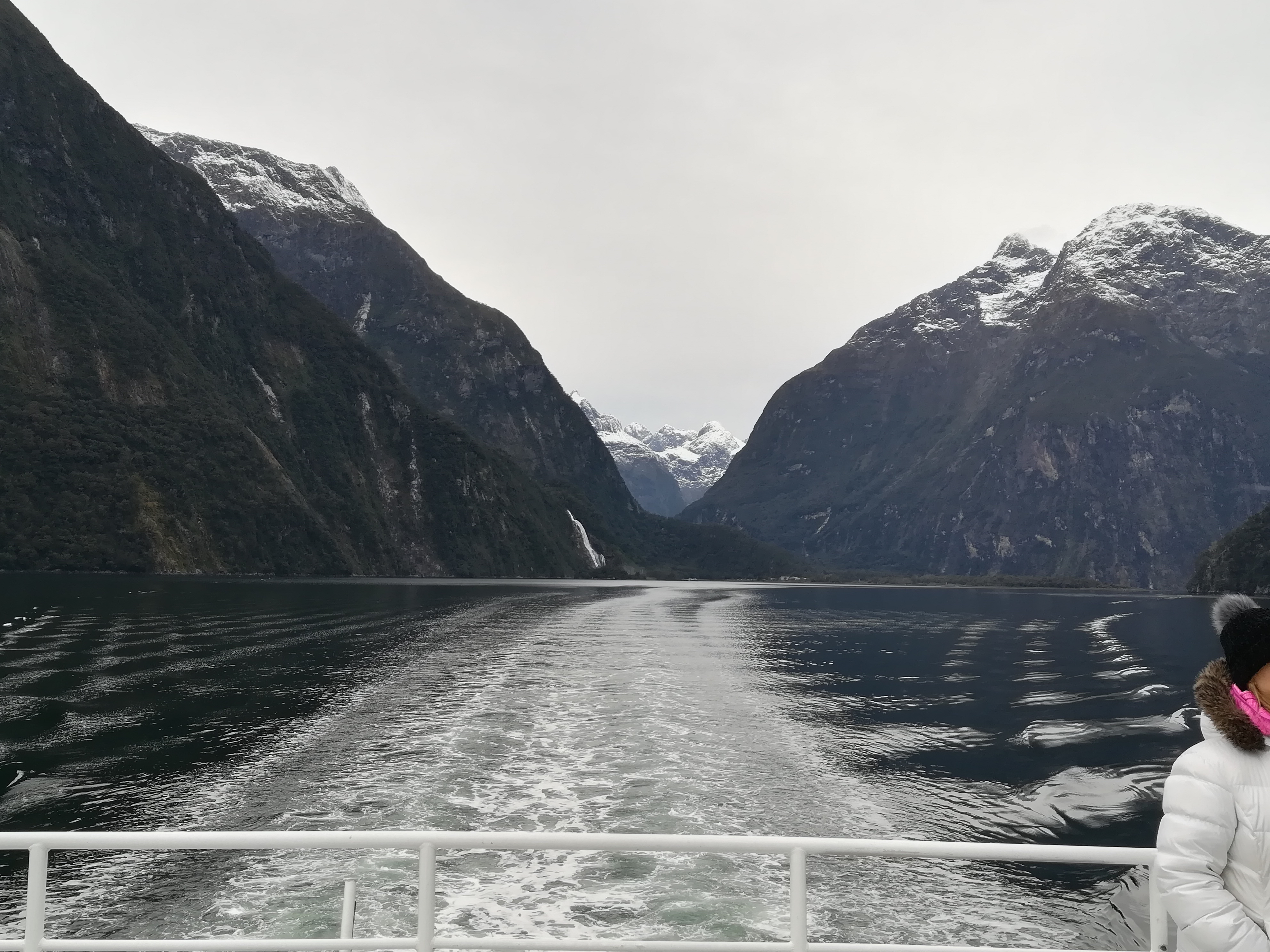
The cruise itself was amazing and completely worth facing the cold and getting a little wet at one of the waterfalls.  We didn't get to see as much wildlife as it is sometimes possible to see, but seeing the dramatic glacier-formed landscape with trees clinging to practically nothing on sheer rock faces made up for that.  

The skipper of the boat not only sailed us around the sound but gave a running commentary as he did so which was both informative and funny.

On the drive back to Te Anau we had planned to stop off at a number of viewpoints indicated on a map of the road we had gotten at an I-site.  However, it turned out that most of these were either closed due to roads works and damage done by the flooding or we didn't see any signage until it was too late to turn without causing an accident.  We did manage to get a stop at Mirror Lakes though for a two-minute walk.

The following day we had planned to walk a portion of the Kepler Trail starting just outside of Te Anau, hoping to get above the tree lines to get a view of the area, but by the time we had sorted out our gear and repacked the car (we were moving to different accommodation that night) it was much later than we had intended.  We carried out the walk as planned, but didn't get to go out of the bush.  

We were thinking that we might not have been able to get much of a view at all as the clouds were pretty low, but at one section there was an opening in the tree line and we could see above the low clouds.  It was a pretty muggy walk and, in this form, probably not worth the trip and we didn't see or even hear much wildlife in the forest, but apparently it's a pretty amazing walk one you're above the bush.

That night we carried out a large purge of all our items as were would only be able to take one bag each onto the TranzAlpine Train and needed to do some decent purging.  Unfortunately, we had to say goodbye to our trusty tent that had served us so well during our time in New Zealand, but hopefully, it can have a new life with someone else.

After dropping off some items at a charity shop we headed to Queenstown where we needed to drop off the car, but not before taking a quick detour to Arrowtown.  I would definitely recommend going to see this town if you're in the area as, the centre at least, is a little capsule of history with buildings from the 18th century gold rush.  

I had wanted to spend a little more time there if we could, but we had to be back in Queenstown for 2pm, so instead we had a little potter around the centre, some lunch, and then went to look at the Chinese settlement - which was the main reason we were there.  It's been pretty unusual to come across information about the non-European settlers in New Zealand, but this was a really good insight into the conditions that some Chinese settlers had to live in and the treatment that many of them received.

We had come to the realisation now that the chances of us seeing a Kiwi in the wild were basically non-existent, at least during this trip to New Zealand.  So, we took a trip to the Kiwi Birdlife Park in Queenstown that happened to also be having a deal on their ticket prices that day.  Not only did we finally get to see three Kiwis, with a hilarious moment were one of the females knew that the noise to her enclosure door meant that more food was coming in and rushed at an amazing speed across her enclosure to gobble it all up whilst the male remained in the back corner, but I also got to see the Tuatara lizard, had my clothes slightly manhandled by a Kea, and got a close up of our favourite bird, the Morepork.   There wasn't really much else we wanted to do in Queenstown, so we had a couple of drinks in town before heading to bed.

The next day was basically just a day driving to Greymouth in bad weather.  We had tentatively hoped to see the Fox and Franz Josef glaciers on the way up, though we knew we probably wouldn't have enough time and that turned out to be true (apart from a vague glimpse).  So they can be added to a time when we can do the trip a little more slowly next time.  Other than that, there isn't really too much more to write about when it comes to this journey.

Our last day of travel saw us spending the morning pottering around Greymouth where there doesn't seem to be too much to do except visit the museum (which was closed), sit in a cafe, and go to a gem of a secondhand book shop called Red Bookstore.  From a tourist point of view, it seems to mainly be about the TranzAlpine Train.  We quite liked it though as a possible place to reside.

When we first organised this trip we hadn't planned on going on the TranzAlpine Train due to the price, but they had put out a deal and, in probably consequence, the train was packed.  I hate to say it, but this trip wasn't as good as we were hoping.  We did get some pretty good views, but there didn't seem to be too many that you wouldn't have been able to get by driving along the road that snaked beside it for most of the journey.  

You are given headphones so that you can listen to the commentary they provide along the route and the sections about Maori inhabitants and early European settlers and explorers were interesting.  However, they did seem to be stretching it a bit to try and find information to provide and, at one point, the they were telling us about a modern building built for the dairy industry.  I guess what is interesting is a matter of opinion, but it seemed a little odd to me.


Our last couple of days were spent in Christchurch with my aunt and uncle and there isn't really anything extra to tell you about on that front.  If you want to find out what I did last time you can read it here in my previous blog.  And then, after a lot a faffing with airlines where I'm going to have a little fight on my hands to get my money back, we were off to the UK on Singapore Airlines and I have to admit they looked after us pretty well.


Sunday, 16 August 2020

Returning to the South Island, New Zealand - part 1

I am now finally back in the UK and the less I think about that 40 hour trip whilst wearing a face mask the better.  Instead, I'm going to think of something for more enjoyable, and that is the trip we took to the South Island just before we returned to the UK, this time to see more of the middle and the west side of the island.  Due to the time of year, the route we wanted to take, and the activities we were planning on doing (Covid-19 had also reduced some of the services) it made sense for us to hire a car rather than rely on public transport (unfortunately).  We managed to get a pretty good deal using a website called transfercar.co.nz.  What car is available is pretty pot luck but we were able to find a pretty small and efficient car which was able to take all our luggage, was insured, allowed two drivers, and was with us for 10 days of our trip for around $150.  Not bad at all.

The first part of the trip was pretty similar to the last time I travelled south, with driving through the centre of the North Island to Wellington (where we stayed with friends) and then catching Interislander to Picton so I won't go over that part again.  You can find it in my first blog about the South Island here.  We stopped off at Oxford to spend some time with my partner's family and then headed to our first actual tourist stop - Aoraki/ Mount Cook.

Stopping off at Lake Tekapo on the way, which was definitely worth that extra time.

We had managed to get a good price for staying at the Hermitage Hotel at Mount Cook, but even so, it was still quite a splurge on our part.  However, it totally worth it as it ended up being much too cold to actually stay in the tent at that time and I have to admit having that little bit of luxury was very welcome.  As we arrived mid-afternoon we decided to first walk up to the Red Tarn before checking in, giving us a pretty good view of Mount Cook and it's surrounding peaks, as well as the Mackenzie Basin.  It also gave us a really good view of the weather rolling in and we decided to head back down before that reached the valley.  We also didn't have the right equipment to carry on any further up the mountainside in winter conditions, and there was also the traumatising fact that lockdown has definitely helped reduce our fitness levels quite considerably.

Though we had initially planned to go there in March, when the weather would have been much milder, there was something very beautiful about seeing the landscape all covered in snow not to mention the extra cosy feel of getting to watch a snow blizzard through the window of your warm room.

We only really had one short day to spend at Mount Cook and, as the conditions didn't match our equipment we decided to take the safer lowland routes that day.  I say safe, there was literally ice the whole way along one of the tracks, including the bridges, but I guess you have to get your adventures where you can.  

Our first destination was the Hooker Glacier, which was absolutely stunning especially in the winter light we had and definitely worth the sort of ice skating we had to do to get there.  There were more people there then we were expecting, but the reduced numbers from what is probably normal in summer, and possibly a Covid free winter as well, was an added bonus to the winter visit.

Next was the Tasmin Glacier walk which passes the Blue Lakes (kinda more like ponds).  Aa much easier walk with no ice but straight up a steep hill.  The view might have been slightly less impressive, but it was still worth the visit and there were a lot fewer people than at the Hooker Glacier.  The Blue Lakes aren't actually blue anymore, more of a green colour, but apparently this is due to the fact that they were named during the 1800s when the Tasmin Glacier reached over the surrounding peaks and feed these lakes with its meltwater.  Now, this glacier doesn't even fill the valley it sits in and the lakes only receive water from rainfall.

After that, we drove to Omarama where we were staying the night in a very different type of accommodation, including only having 5 minutes of hot water for both of us to shower in.  However, I got a really yummy vegetarian meal and some good beer at the Boots and Jandals Hotel (not the place we were staying in).  There isn't a whole lot of things open at Omarama during this time of year, and also probably due to Covid-19, but we did manage to book a section at HOT Tubs Omarama from 8.00pm to 9.30pm, which meant soaking in what looks like a giant cauldron whilst getting a really clear view of the stars and listening to Pukekos.  You can also book these during the day, but I would definitely recommend going at night instead.  I would also recommend not eating as much as we did an hour before getting in, made it ever so slightly less comfortable then it should have been.

The following day saw us driving to Wanaka, mainly to visit more of my partner's family.  This time we decided to camp as we had already been pushing the budget just a little bit and needed to save some money.  We went for the campsite right beside the centre of town called the Wanaka Lakeview Holiday Park and it turned out to be a really good choice with great facilities.  It also helped that they gave us a good spot right beside those facilities ensuring we were only a hop, skip, and a jump from the loos and (more importantly) the warm lounge.  After initial hellos to the family, we headed off to set up camp and then visited the 'Wanaka tree' that you see on all those Instagram photos.  It is a beautiful tree in a great setting, but I'm not sure if I'd go as gaga about it as some people do.  

We were also lucky in that we had unintentionally arrived on Matariki, Maori New Year, where we were entertained to a couple of bonfires on the beach, a band, and some fireworks.  There was also hangi, which normally contains meat but they did a vegetarian option giving me the chance to get an idea of the flavours.

The following day we were meant to start with a walk, but the night before had been much colder than we had been expecting and ended up being pretty sleepless.  So instead, we enjoyed snoozing as the morning sun warmed up the tent.  Then it was a quick but wonderfully warm shower before we pottered around Wanaka town centre.  It's a very nice town with a good number of outdoor shops and cafes.  However, the type of shops and prices definitely shows the wealth of the area.  That afternoon we drove up to the Treble Cone ski centre for more family time, though we didn't do any skiing ourselves.  However, perhaps the highlight of the trip was getting to see a couple of Kea not exactly in the wild, but definitely not in captivity.  The orange of their underwing feathers is really striking and it's really enjoyable watching their mischievous behaviour.

And then we were off further to Southland for more site seeing and walking, but I will save that for the next blog.

Sunday, 3 May 2020

Travelling - Northland, New Zealand


This trip to Northland obviously happened before the lock down started, but I thought it would be nice to have some pictures of the outside world for us to look at.  It was only a four day visit as, unfortunately, that was all the time that we could put aside this time.  However, even though the Northland is not given as much advertising as a tourist destination in New Zealand, I really wanted to see it.  Due to the distance there was quite a lot of driving, which isn't my favourite way of seeing places, but needs must.


On the first day we started off a little late as we needed to sort out our gear first, but we wanted to get quite far north that day to make sure we made our main goals possible on day two.  So that night we stayed at Paihia, which has some nice gift shops and what looks like nice places to eat, but the main thing us was the view into the Bay of Islands.  We decided to just grab some snack like foods for dinner and sit in the car parked at the bay to enjoy the scenery whilst we ate.  It was a little murky and dull that day, but still beautiful.


The main attraction of Paihia is the Waitangi Treaty Ground, but that was a little bit out of our budget for this trip so we contented ourselves by walking over the bridge to the area and having a bit of a wondering around the neighbouring park. 


The second day was all about the original European capital of New Zealand, Russell.  First stop was the flag post at Maiki on the Flagstaff Hill Historic reserve to see the site where the British flag post was cut down four times by Hone Heke, chief of the Ngapuhi, over the fact that the treaty had not brought his people prosperity and the increasing control of the area by the British.  It does seem like quite a legitimate reason to cut down the symbol of the British Government in that area and the fighting that followed really showed the in-experience of the British and the experience and honourable behaviour of the Maori, they did far more to protect the local British, non-military population then their own Government did.


We then walked back to Russell through the Kororareka Point Scenic Reserve.  The tide ended up being a little higher then we expected, so the final beach walk ended up being a scramble over the rocks in our flip flops - always fun.


Then it was time to have a good look around Russell itself.  The main streets still contain quite a few of the older buildings and it has quite a nice relaxed feel to it without all the touristy shops that you would normally expect.  In fact it had quite a few pre-loved and craft shops for the size of the place.  We made sure to stop at the museum, which was small but full of information, and the church where you can still see holes on the outside musket balls on the outside and to whom Charles Darwin actually donated money to the building of.


To get to Russell and back we took the ferry (which is pedestrian only), and it's a really nice way to first see Russell and the bay.  Probably beats the long, winding round you would otherwise have to take any way.


After a lovely morning pottering we carried on the drive north.  We made a pretty quick stop (and by quick I mean I almost did an emergency break, but decided to control myself) at the Living Nature factory shop.  I love their products so was keen to see the place where they are made.  Unfortunately we couldn't see the factory that time, but I had a good nosy through all the products in the shop.  Then we stopped at Kerikeri to get supplies and visit the Kororipo Pai.  There isn't a lot still visible at this Pai, but you can see the terracing that once supported the wooden palisades that make up these fortresses.  We also took a quick leg-stretching break to see the Rainbow Falls.  The waterfall was beautiful, but we didn't get to see any of the rainbow colours they are names after, probably because the lighting was a bit off that day.


Our stop for the night was the most northern campsite in New Zealand, the DOC owned Tapotupotu Campsite.  This is a really beautiful campsite and there was enough space for us to get a spot away from other people, but there was a warning about blood sucking insects (thankfully it was very windy that night so we were left alone).  The best part about it was that we were able to have a swim in the sea first thing in the morning and then have a little rinse off in the river that was right beside our tent.  It was a little chilly, but still a really good way to start the day.


The main aim of this trip was to visit Cape Reigna, the most northerly point that you can physically reach in New Zealand.  This is the most sacred site in Aotearoa to the Maori as it is believed to be the launching point of a deceased person's spirit as they return home and you are asked to not eat or drink whilst visiting.  The actual point is an 800 year old pohutukawa tree that you can see clinging to the side of an outcrop of rocks, but this point can't be visited by anyone from the living.


It is a beautiful spot and the views were amazing, helped by the great weather we had that day.  Definitely worth driving this far north to get to see this site.  The location also has lots of really good plaques everywhere telling you about the site, why in is sacred, and about Abel Tasman the Dutchman who was actually the first white man to discover New Zealand.


We had decided to drive back down the west coast instead of taking the same route back, choosing a route that would take us through Kohukohu, known for it's beautiful Victorian buildings.  It did not disappoint, they were gorgeous and a very good example of Victorian buildings done the New Zealand way (which mainly means using wood).  We then took the ferry to Rawene (the third oldest European settlement in New Zealand), which also had a lot of beautiful old buildings and many, many, many churches.


Of course, we had to stop off in Waipoua Forest to see Tane Mahuta, named after the Maori forest god.  It's the largest kauri tree still alive and it probably around 1200 to 2000 years old. Am absolute beauty which was lucky enough to be missed by loggers in the not to distant past.


That night we stayed at this amazing campsite at Kai Iwi Lakes, not surprisingly called Kai Iwi Lakes campground.  As with Tapotupotu Campsite we had a lot of space to choose with not many people looking for spot.  This is probably due to the fact we were visiting a little out of season and Northland was dealing with a drought at that moment.  This lack of water had meant that we weren't able to stay at the campsite we had originally planned on, mainly because they offered kiwi tours during the night, but this campsite definitely made up for that disappointment.  Just look at that view!


The next morning we went for a swim in Kai Iwi Lake and it was a slightly odd experience.  This lake has no in-lets or out-lets and the amount of water found in there is determined by the amount of rain water it received and how much evaporates off.  Without the usual salts and minerals that is was a much harder to float and swim in that water.  It was also strange to open your eyes under the water, with everything much more blurry then in other waters I've swam in.  It was absolutely beautiful to swim in.


After our morning swim we carried on down south through Dargaville were we wanted to see the museum there.  This museums differ from other ones I've been to in New Zealand in so far as most of the European settlers in the area were actually from Croatia and the main industry was gumdigging.  This was an interesting museum, which also contained information about the Greenpeace ship, Rainbow Warrior, that was blown up by the French in 1985 whilst at Auckland Port as they were planning to protect against French testing nuclear arms at Moruroa.  The masts are mounted outside the museum in memorial of Fernando Pereira who died on the boat as it sank.  It also turned out to be a good place to end up around lunch time as we found a vegan cafe called Taste and See.  The food was really good, the prices were really good, and it contained a small shop with natural food and beauty products in it.

And then we headed back down to Auckland.

Northland is a really beautiful area and there was definitely not the same level of tourisms here I've found in other areas of New Zealand.  This ended up making it a really good place to visit and, despite the fact this is not usually high on most people's list of places to visit, it should be.  Definitely worth going to and we'll be returning to see more as soon as we can.