'It is better to light a candle than curse the darkness' Proverb
Showing posts with label Ethical living. Show all posts

Sunday, 30 January 2022

Preparing for my Wedding

I'm getting married this year and though it's going to be small in comparison to other weddings, there are still some expectations that mean it's not exactly going to be the wedding we want.  However, we still want to have a wedding that represents us as much as possible and we also have a budget we need to try and stick to.  The budget has meant that we've needed to do a lot of the things ourselves to save money.  So, this is the plan.

Guests

With things being the way they are at the moment with Covid we've decided to just have family who are already based in the UK coming to our wedding.  For everyone else, we'll be streaming the ceremony so that they can watch it from the comfort of their own home.  This will hopefully mean less disruption if we have to return to more restrictions.  It also means we are having a smaller wedding more in keeping with what we want and it reduces the travel miles connected to our wedding.  

For our smaller wedding, we wanted to make the wedding invitations ourselves to add a personal touch.  The cross-stitch pattern is a Pictish design that I've had for a while which comes from the area of Scotland we first met in.  The thread I used is from cross-stitch projects I've been doing since meeting my fiance.  Unfortunately, we didn't have time to make invites for everyone so to add a personal touch to the other invites I hand wrote them and made origami hearts to send with them.

Clothing

I'm planning on making as much of my clothing as possible, which includes the skirt, overskirt, petticoat (I was looking for this in charity shops, but unfortunately haven't been able to find anything), off-shoulder top, shawl, matching face mask, and I'm borrowing my Mum's veil.  I will be using some fabrics I've never sewn with before and I'll have to make up some of the patterns, but I have time and I think I'm going to enjoy the challenges these are going to bring.  I'm wanting to use second-hand fabrics whenever I can and have already been able to source some good pre-loved cotton sheets for the main body of the skirt and top.  I'm still looking for some net curtains or table cloth to make the overskirt with, but hopefully, I'll find that soon.  The plan is to write blogs about each garment so look out for those.

For my partner, we've gotten him a suit that's made out of recycled plastic from Moss Bros.  We're still looking for a shirt for him, which will hopefully be a charity shop find, and I'm hoping to make him a tie that matches my skirt and a face mask to go with his suit.  We'll have to see how much time I have first though.

Food

We didn't want anything overly fancy for this as that's not really our style.  So a nice pub lunch at a lovely pub in a beautiful location is the plan.  We've got a table or two booked at the relatively local Hope and Anchor Inn, which has locally sourced food and drinks.

My Mum is wanting to make a traditional wedding cake for us, but we're also ordering brownies from our favourite bakery - Dammn Good Bakes.  The brownies are a really good size and they're connected to a date we had.

Flowers

I was in two minds about whether we should have flowers or not, especially with the negative environmental and poor employment practices connected with the mass flower production we have now.  However, they are a beautiful thing to have at a celebration so we had a search around to see if there were some sustainable options.  We did actually find quite a few companies in the UK that had more sustainable practices, but we were lucky to find a company that was just down the road from us that sources flowers from local suppliers and is woman-owned, called Wildflower Floristry.  (Side note: the flowers photographed aren't hers.  Just flowers I brought because I wanted some in the flat after all the flower research.)  Best of all they use wildflowers (funnily enough), which are my favourite type, and I'm looking forward to having a bouquet that looks like a wildflower meadow.  For that very reason, we haven't asked for any particular colour scheme for them, apart from as much blue as possible.

They also normally offer vase hire for the table settings, but we've decided to do some charity shop hunting to buy vases so that our guests can take them away with them at the end of the meal.  Lucy, the owner, was really lovely and it's definitely been one of the best, and least stressful, parts of the wedding preparations.

Wedding Gifts

This is a pretty standard one.  There isn't really anything that we want, at least that we can fit in our flat and that is affordable for other people to buy for us.  So instead, we're asking people to donate to charity.  We've set up a Go Fund Me page for this very purpose which has the charities we would personally like to support. 

Favours

This is similar to the wedding gifts in that we wanted them to be a way of supporting charities.  So the favours we brought for everyone are badges from RNLI (with one of my favourite pictures) and wildflower seeds from Wildflower Favours to support the Bat Conservation Trust.

Wedding Day Activities

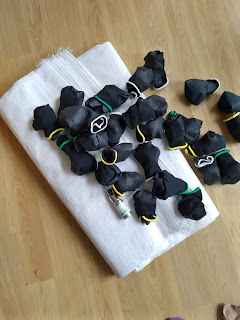
A day that's all about us and is a big party is not really our thing.  We're also having the wedding in the morning, which would make it a very long party and who has the energy for that.  So instead, we're doing things that are much more us.  This includes a walk along the coast before lunch (weather permitting) and a beach clean afterwards.  We got in contact with Surfers Against Sewage to set up our own beach clean for the day and they have very kindly sent us a beach cleaning kit for everyone to use.

So that's hopefully going to be our wedding.  There are still a few things to organise and work through, but that's most of it done.  Even though this is meant to be an enjoyable occasion I've actually found most of this quite stressful, which is unusual for me - possibly because the idea of being the centre of attention all day is quite off-putting to me.   However, now that I mostly just have to worry about making my clothes I feel that things will get a lot more enjoyable.  At least with that, I get to be creative.

Sunday, 24 December 2017

Living Out of One Bag


My six month traineeship is now over and I'm looking for work in the field of path construction.  Right now I'm homeless and if I do manage to get the work I'm applying for I could be travelling all over Scotland staying in work cottages and hostels.  Due to this I want to be able to fit my life in a bag I can carry on my back.

As a quick disclaimer I'll also be taking my Eurohike wellies carrier in which I keep my work boots, work waterproofs, and work PPE (all of which get very dirty and which I like to keep separate). 

At the moment I have way more stuff then I could possibly carry on my own and after having to move it all down to my parents I am now keenly aware that I have too much stuff.  Firstly I need to go through everything and have a major declutter of everything I don't use and really don't need.  I think I got used to having space in my homes and so kept items I didn't really need.  I also have a tendency to get emotionally attached to things and keep them for that reason only.

Then I need to go through the items I have felt and work out what I need to take with me for work and any additional items for the day's I'm off work.  It's going to be a balancing act between what I want to take with me and what I can actually fit into the bag (which is 65l in size) and carry. 

I'm lucky that my parents have said that I can keep some items at theirs over the next year, but I don't want this to be a long term solution or an excuse to hold onto more then I had originally intended.  So I'm going to be to be very strict with myself and to keep myself on track (and accountable) I'm going to document what I'm doing on this blog.  Even if my life changes I still want to keep what I own to a minimum so this process will still be important.

Sunday, 17 December 2017

Mini Film Review: Earthlings


Just like Food Inc I've been putting off watching this documentary (probably more so) as I knew it was going to be a really difficult watch. And it was.

Released in 2005, it was made by filmmaker Shaun Monson, narrated by Joaquin Phoenix, and using footage predominantly shoot using hidden cameras it looks at the suffering animals go through in factory farms, puppy mills, the entertainment industry, research labs, and more.  It even draws parallels between the issues of racism, sexism, and what they have called speciesism.

Separated into sections which first looks at how we treat animals we see as pets, and then looks at animals for food, animals in entertainment, and animals for research purposes.  The documentary didn't show me anything I wasn't already aware of, but there's something about actually seeing it that really brings the reality home.  Perhaps the most disturbing part wasn't just that a person could be so indifferent to the pain of the animals under their care, but that they were actively enjoying inflicting even more pain on them.  Knowing what psychologists say about this type of behaviour and its connection to how these individuals actually treat other humans, it doesn't bode well for the human race.

They do also make some valid points about the connections between factory farming and the spreading of some very deadly disease, as well as the fact that positive results in animal testing doesn't necessarily mean positive results in humans (in these cases they start the tests on 'lower' mammals and work their way up which is meant to make them certain of the medicines safety).  

Whether you believe that all animals deserve to be treated with respect and dignity for their own right or that it's all about the health implications it has for humans, the one thing this documentary does make obvious is how absolutely dependent we are on the animals we show such little respect to.  It has definitely given me more impetuous to carry on becoming more cruelty free in my lifestyle.

Sunday, 10 December 2017

Ethical Christmas Gifts


Christmas seems to be a time of year when all my attempts to live more sustainably goes out the window.  I have all the excuses: that it gets very busy; I don't have a lot of money; I'm buying presents for other people......  But I want this year to be different.  My budget may be even lower then it has been in the past but, I think with a little planning I should be able to do everything I want to.  Even if I don't, the experience will help me improve what I do next year.

This year I want to focus on the gift giving side of things.  Depending on what my family wants I may still have to buy some items less 'ethically', but this is how I'm intending on purchasing sustainably this Christmas.

Buying from Christmas Fairs
The number of craft fairs increases around Christmas time and it's usually a good place to find locally made, hand crafted products.  Don't get me wrong they can be a bit hit or miss, but they are also an opportunity to support local crafters and I'll definitely be looking at any I can find so see if I can pick up a gift or two.

Shopping Online
Unfortunately where I live doesn't have a whole lot of shops which sell products with an ethical and/or sustainable back story, so it looks like I'm going to have to hunt online.  I'll be looking at the usual websites, like Etsy and Not On the High Street, but I have also found other online stores like Ethical Superstore, Ethical Shop, and Be Good Shop to try out.  The questions I'll be asking when doing the shopping (other then would they like it - obviously) is:

  • Is the item made from sustainable and ethically sourced materials?
  • Is it Fair Trade and does it support local communities?
  • Is the item made in the UK?
This is all the questions I'll be asking this year, but if it goes well I'll add some more for next.

Wrapping the Presents
Every year I buy rolls of wrapping paper which only get thrown away at the end of Christmas (the way Christmas paper is made means a lot of it can't be recycled).  So this year I want to do something which produces a lot less waste and have been thinking about furoshiki (a type of traditional Japanese wrapping).  I've decided to buy some scarves and fabric from some charity shops to wrap the presents in.  That way they will also get a scarf to wear if they like it or they can donate them back to a charity shop.  That way the charity shops get an income from the first sale (and possibly a second if they are donated again) and no additional paper needs to go to the landfill.

Christmas Cards
This is the one item I have already brought.  I don't send out too many any more thanks to social media.  But of the ones I do send  out I always make sure that the cards are recyclable and I always buy cards that help support a charity.  This year I've brought from the RSPB, but a pick a different charity each year.  I'm also looking into making some of them myself, and this might be a more sustainable option in the long run.

Christmas can be a really stressful time of year and it can be difficult to remember some of the ethos you have been trying to live by the rest of the year.  I am still learning, and always will be, but I think if I can give it a good go at this time of year then the rest of the year should feel like a breeze.

Sunday, 19 February 2017

Being positive when things seem bad.

I was going to write this blog about the election of Trump  and, after a short period to see what he would actually do, see what implications this would have on the protection of the planet.  However, there are enough people discussing this already and, seeing as we can't change this now, would it really be helpful.  So I've decided to write about something else.

A little while ago I saw the card above and bought it for no reason other than to have to look at now and then.  It is amusing, but the reason I brought it is to be a little reminder that, no matter how bad things get, it could be worse.

There have been a lot of changes over the last year and a number of them look like they could have very serious implications for the environment (Brexit and Trump as President are two things that immediately come to mind) and it would be easy to fall into doom and gloom.  The problem with this is that if you only focus on the bad it's easy to get disheartened and to just stop trying.  But, it could be worse.  

Those that are elected to run our countries may seem to be lying gits who turn their back on everything they promise up to the election and put their and their friend's interests first.  But, at least we did get to elect them and if we gave them the power to rule this time we can take it away the next.  Even, while they are in power we can constantly contact our MPs about subjects that are important to us, and the more we do so the more they'll know what will keep them where they want to be - on top. Pester power doesn't just work on parents.  We may need to change the way we vote though (that's whole blog in itself).

There are many people still living a highly unsustainable lifestyle, following the more is better rule we've been taught which is so destructive to the one thing we need to live -  the planet.  Yet there is a growing number of people turning their back on this lifestyle for so many reasons and as more people see how easy and beneficial it is those numbers will increase.

The people who seem to have all the say are those with all the money - the CEOs of companies, stakeholder, supermarkets, the banks......  However, the truth of the matter is that we are the ones giving them the money and we can change what they do by where we decide to put our money. By making more ethical decisions in our purchases we are telling these companies and individuals that this is where they'll make money.  It might start off a bit pricey to begin with, but once more people buy it the cheaper it'll become.  Free range eggs is an example where the prices have dropped over the last few years because it became a more popular choice with us buyers.

Things aren't great at the moment and we're probably worse than the toothbrush, but we're not at the toilet brush yet.  There's still time and...... it could be worse.


Sunday, 13 November 2016

Fracking in the UK

I had meant to write this blog at the beginning of October when the Government's decision on fracking in Lancashire came through, but as I've been behind in my blogs I'm afraid this is coming now.  I still wanted to post it though, especially after the Scottish Government's report brought out yesterday, and the time has given me the opportunity to read even more information on this.

So, to begin - what it fracking?

There has been so much information about fracking recently it is very likely that you already know this, but just in case you don't.......  Fracking is the slang for hydraulic fracturing and is the method of extracting gas or oil trapped below impermeable, shale rock that cannot be collected through conventional drilling alone.

It involves drilling vertically for about 2km (this part we've been doing since the 1940's for conventional oil extraction) and then drilling at a 90 degree angle for around 3km (a relatively recent discovery).  The gap between the borehole and the rock is then sealed with concrete and around 10 million litres containing sand, lubricating fluids and other additives are pumped into the borehole under extremely high pressure.  This opens up the cracks found throughout the shale and these cracks are kept open by the sand particles allowing the gas to escape.  A well head is then installed on the surface to capture the released gas.  Once all the gas and/or oil has been removed from that area the well head is then removed and the shale rock returns back to its original position.

Problems associated with fracking.

Most of the information we have on the issues associated with fracking comes from America, where fracking has been used as a method for extracting fossil fuels for many years.  Despite the claims of clean and safe methods by the fuel companies there have been many reports of health issues and environmental contaminations in connection to the fracking industry.  Research by Duke University (later published in the Proceedings of the National Academy of Sciences in 2011) testing the drinking water at 60 sites across Pennsylvania and New York and found that the drinking water near fracking sites had levels of methane which were in the range designated dangers by the US Department of Interiors.  

While there is not a legal requirement in America for companies to make public information regarding the chemicals used in their fracking process, compounds like benzene, ethylbenzene, toluene, and n-hexane have been found to be released into the air in fracking areas.  Long term exposure to these chemicals are linked to birth defects, neurological issues, blood disorders and cancer.  

There has also been a connection between the industry and earthquakes with previous non-earthquake prone states, such as Ohio and Oklahoma, experiencing strong seismic activities.  The UK itself has experienced this when in April 2011 Cuadrilla Resources first well in Weeton, Lancashire, caused two small earthquakes and dozens of aftershocks.  Tremors were felt in Blackpool and the company had to halt works for an investigation to occur.  However, they did carry on drilling in other wells. 

Fracking in the UK.

While we do have a relative large fracking industry off shore in the UK, onshore fracking is still only at the exploration phase at the moment.  A report by the British Geological Survey, published in 2012, estimated that could be as much as 1,300 trillion cubic feet of gas in the North of England alone, stretching from Lancashire to Yorkshire, which could supply Britain with electricity for decades. Other areas have been ear-marked throughout the UK.  However, it is still not certain how much oil or gas is actually commercially recoverable with more exploratory drilling needed to give us a clearer picture.  Companies such as Cuadrilla, Becconsall, Celtique Energies, and Coastal Oil and Gas have all requested licenses to drill exploratory wells onshore in the UK, with many of the sites receiving the go ahead from the UK Government.  These are still few in number, for now, but the United Kingdom Onshore Operators Group (UKOOG) is expecting the number of these exploratory well sites to increase to 100 over the next 10 years.  However, a license from the Government does not allow the company to start fracking straight away as they also have to receive planning permission from the local councils.  Unfortunately, it seems that a council's ability to determine if fracking occurs in their local area or not has now been taken away from them as the British Government last month overturned the Lancashire County Council's decision in June 2015 to prevent fracking at Little Plumpton (as yet there has been no decision on Roseacre Wood). 

To support fracking Downing Street has promised to fast track shale gas planning applications to 'crack down' on councils trying to delay any decisions on this and has offered tax breaks to fracking companies.  In December last year MPs voted to allow fracking to occur at 1,200m below our National Parks, Areas of Outstanding National Beauty and World Heritage Sites despite pledging on outright ban on National Park earlier in the year. 

It is expected that fracking will be different in the UK to the USA due to difference in the geology (which will theoretically lead to a smaller footprint), the stricter standards for well quality with regular inspections and the more stringent regulations, such as requiring the companies to monitor the water quality throughout the fracking process and disclose of which chemicals they are using.  Also the British Government already has restrictions on a number of the chemicals used in the US and will have higher standards for dealing with the very large amount of radioactive and toxic wastewater that is produced from fracking.  Rather than being burnt, as it does in USA, excess gas produced by this process will be captured on the surface and fed into the national gas supply.  However, despite these promises of higher standards Cuadrilla Resources has already been warned by ministers for failing to recognize the damage done to it's well by the 2011 earthquake and for failing to report this for 6 months. 

Tuesday's report from the Scottish Government has shown that, while there was sufficient evidence to suggest that there would be a number of air and waterborne environmental hazards in connection with the process which could put at risk those living near to fracking sites and those working on site (breathing in crystalline silica), there was inadequate data to determine if the developing of fracking would pose an overall risk to public health.  Some have argued, though, that this report hasn't taken into account that a number of the potential fracking sites are located in densely populated areas.

Why the Government says it's necessary and what might be wrong with this statement?

The UK Government has been pushing for onshore fracking stating that it would reduce our reliance on imported energy, generate economic benefits, especially for local councils, and create tens of thousands of jobs.  They have used the US as an example of how it reduces the cost of electricity and heating, and have argued that fracking will be in keeping with the UK's moves towards low carbon energy systems. With all these we have been told that it would be 'irresponsible' to not carry out tracking wherever we can.

However, fracking will only help the UK transition to low carbon energy systems if it is replacing a higher carbon energy sources, such as coal power.  At the moment the carbon benefits of shale gas is actually still unclear (shale oil even more so) and new evidence from the USA has shown that while fracking has reduced coal consumption, it has not significantly reduced the emission of greenhouse gases.  So, even if it is classified as a low carbon energy system it is unlikely to greatly reduce our carbon emissions over the coming years.  

The cost saving may also not be as high as the Government has been stating either as the UK isn't as sparsely populated as the US but also the higher regulatory standards found in the UK will, perhaps ironically, mean that companies will have to invest more into their infrastructure, significantly reducing the cost savings actually seen by us customers.  Economic and job improvements to local areas will also be temporary as fracking is not a permanent process and wells that run dry are then closed down and the infrastructure then moved.  As companies will likely want to move skilled staff with them rather than go through the cost of retraining, it's debatable whether the increase in employment potential is likely to be as high as originally promised.

The uncertainty around the safety aspects is still the main worry for many people and the Government's own Strategic Environmental Assessment (SEA) themselves have highlighting the uncertainties associated with the impacts of shale gas.  The impact of shale oil is even more uncertain and these are not adequately covered by the safety measures put in place for shale gas.  There are also other environmental factors specific to the UK that need to be taken into account, like the water shortages in the South East which would make fracking in that area unsustainable and the fact that we are a much more densely populated area so any breach in the safety standards could have quite severe consequences.  The recent issues with oil leaks in our oceans has made many question how prepared our oil companies are to deal with a major contamination event, such as waste entering our water supplies, and whether they even have adequately insurance.  

Perhaps the biggest issue with fracking is how it is taking us further away from the actions we need to take to prevent climate change.  Scientists have already calculated that, if we are to avoid two degrees of global warming, we must leave four-fifths of the already known fuels in the ground and yet our Government is now setting us on a path to find and extract more fossil fuels then we know of already.  Based on the evidence coming out of the US this is unlikely to help us meet our targets or help us set in motions the work needed to take us off fossil fuels and move us into more renewable energies.

One thing I think is important to note here is the differences between our Government's behaviour towards onshore fracking and onshore windfarms.  Both would generate an income for local councils and Britain as a whole.  Both would reduce our reliance on imported energy and, it could be argued, windfarms would reduce this reliance for longer.  Both would create tens of thousands of jobs, with jobs remain in local areas for longer at windfarm sites due to their maintenance needs, while fracking moves away once all the fuel has been removed.  And an increase in windfarms will also reduce our electricity and heating costs in the long run.  Yet, while the Government have stated, unequivocally, that they will push forward fracking even if local councils rule against it occurring in their county, local opposition to windfarms have been given the power to block applications.  While fracking companies will be getting tax breaks, they are planning to remove subsidies that windfarm companies receive.  The Government has also promised to provide cash handouts to local people in fracking areas and yet the same incentive is not offered to those living in areas of onshore windfarms.  This is despite onshore windfarms being proven to be a low-cost, low-carbon alternative to fossil fuels.  Of course, I couldn't possible comment on why they may have made this decision.

There are a number of sites you can go to to get more information.  Not surprisingly Greenpeace and Friends of the Earth have information and Frack Off allows you to see all the locations in the UK connected to fracking.  But, to get the Government's point of view it's worth looking at their own publications, like their guidance to fracking and their FAQ page.

Sunday, 19 June 2016

Mini Film Review: Billions in Change

The next film I want to write a little review about is Billions in Change (and this movie you can actually get free on YouTube).  It's about the Manoj Bhargava, who invented 5-hour ENERGY, and what he's done with the money he has made selling this product.

We're so used to, now, watching people make money for nothing and then basically spending it on themselves.  But this isn't the case with Manoj Bhargava who doesn't see the point on spending his money on 'stuff' and has instead decided to put it towards something a little more useful.  Manoj is putting 99% of his projects into the funding inventions which will help fix the world issues of water, energy, and health care.  He is genuinely excited by these inventions and what they could do for a planet as a whole.

It's a good reminder of what one person can do if they choose to.  I know in this case Manoj has a lot of money to give, but even the littlest actions by someone can help make a difference.  It's also great to see someone using their money for something other than just buying stuff for themselves and how genuinely happy this has made him.

You can watch the full movie here.