'It is better to light a candle than curse the darkness' Proverb
Sunday, 22 September 2019
Goals for 2019 - Update #3
I wish that I could say that I completely turned around my goal achievements this quarter and am now on the road to completing all my goals by the end of 2019. This is, of course, completely untrue. 😂 To say that I've been a little preoccupied would be an understatement and some of the goals I had set for myself have drifted off to do their own thing. Needless to say, the outcome hasn't been particularly healthy or good for me and I now have one more quarter to finally get them on track.
Healthy Eating
On the whole my eating has gotten healthier this quarter, with me putting even more vegetable into my diet and, overall, reducing the amount of gluten I've been consuming. I've actually lost a little bit more fat and, more importantly, my body feels much stronger than it did before. This is most definitely helped by the work I do, but a good diet is really important to keeping your body healthy when working it hard.
Where I've fallen down on the healthy eating is with my usual nemesis, sugar. I haven't really been paying attention, but when I actually started keeping an eye on what I was eating this last month I realised that I had definitely fallen back onto having quite a few sugary treats. Not just that but it was happening more often and the amount of sugar each time was increasing. You might think that, with the very physical job I do, this extra sugar wouldn't really matter too much, especially as I'm still losing fat. But sugar does more bad things than just help you put on weight and I know how important reducing my sugar is to increase my bodies general well-being. So, I'm going to give reducing it yet another go again this quarter (if at first you don't succeed and all that), but might need to bring in some helpers again in the form of fizzy water (totally ridiculous I know) and crunchy snacks.
I'm going to let myself be a little bit more relaxed about it over the weekend, but I don't want to slip too far the other way and just binge on sugar for two days a week. Time to start showing some real restraint. I know I can, I've just been being lazy and let the little sugar monsters reign in my brain.
So, I failed on my mini goal for this quarter, but I'm going to roll it on to the next. Sugary treats only on two occasions a week.
Reducing Waste
On the whole I have managed to reduce my waste quite a bit these last few months, and that's predominantly due to me doing even less shopping than before (if that's actually possible). The one place in which I am still struggling, which surprises me a little, is food shopping. My diet is predominantly plant based and you would have thought that that would have meant that there would be almost no packaging at all in my basket. However, in a number of shops I've been to there is plastic wrapped around every vegetable. I don't really understand why this has now become the case and I really don't understand the hygiene argument a lot of shops give seeing as you wash your veg before you eat them anyway.
Co Op seems to be the worst offenders of this at the moment, which is frustrating as it's one of the shops I end up having to go to most often. I have been keeping an eye out for farm shops as I travel around, but these mainly seem to only sell meat and eggs with not a lot of vegetables, so they haven't been the help I was hoping they were going to be.
Whilst I did try to carry out my mini goal for this quarter there is definitely more work needed as it didn't exactly work out. I'm going to keep looking for other options and possible solutions to help reduce the amount of waste I produce, but if you have any suggestions please let me know. They would be greatly appreciated.
Learning New Skills
Work
I took the dry stone walling course in July and have already written a post about it, which you can find here. It was really interesting and gave me a good insight into a different way of using stones to build structures. It is definitely a future job I would like to look more into, but as it requires a lot more training than I have time for at the moment it'll probably be something I come back to later on.
As before, trying to learn the names of different flowers is something I keep coming back to whilst at work. This is a slow process, especially as it can only take place during breaks or the walks to and from the work sites, and will probably take a while before I feel really confident about it.
I have also found someone who may be able to help me with having a refresher on my navigation skills, and I'm going to contact them and see what they say. I figured this was a much better option than just winging it on my own in case I'm making some very serious mistakes that might need rectifying.
Mini goals is definitely a tick for this quarter and I'm planning on getting the navigation skills sorted for the next. Then this goal at least will have been a success.
Home
I now have a new, well second hand, laptop which means that I now have the software I need to carry on doing my BSL learning. It's been great getting back to learning this again and I've been enjoying it, despite the fact that we've now moved onto more complex, scary stuff like stringing a sentence together. This does mean that I am having to learn a new form of grammar, which I have to admit is freaking my brain out a little. But it's all part of keeping your brain active and healthy.
My mini goal here was to try and do one BSL learning section a week, but I've actually managed do more than that and have noticed a difference in the amount I've managed to take in. My mini goal for the upcoming quarter is to finish this course and I've put a timetable in place, as if I was back at school, which makes it pretty likely I will achieve that my the end of the year.
So, the learning new skills goal has gone pretty well so far, but the other two not so much. I'm trying not to be negative about this as it won't help and I still have three more months to ensure that I get back on track. Whilst the sugar goal is probably going to be the most difficult personally, the reducing packaging goal is probably going to be the most frustrating as it is the one least under my control. However, my aim is to end this year on a high note and I'm now more determined than before to do that. Onwards and upwards.
Sunday, 15 September 2019
The Concept of Shifting Baseline Syndrome
I have a very specific memory from the beginning of this year which keeps cropping up in my head. It's the memory of the strong feeling I had when I had finished working in a beautiful Caledonian pinewood and started work in an area of land that is managed for grouse shooting. The conspicuous contrast in the amount of life you could see and hear in these two habitats was very evident and made me think about the other moorlands I drive and walk through a lot in Scotland. Knowing as I do that Caledonian pinewoods used to cover large areas of Scotland before cutting, burning, and grazing depleted them to just 1% of their original extent, it's made me realise just how 'unnatural' a lot of the Scottish landscape actually is.
And yet many people don't see it as unnatural at all. They see it as rugged and wild, untamed and one of the last natural places in Britain, completely unaware of just how managed it is. I know this as I used to be one of these people and it made me wonder about how it is that we can be seeing a landscape so falsely? How are we not seeing nature as damaged as it actually is? So I did what I always do when I have questions and started researching, and during my research I came across the concept of Shifting Baseline Syndrome.
The idea of Shifting Baseline first appeared in a landscape architect's, Ian McHarg, publication 'Design with Nature' in 1969 when he was comparing modern landscapes with that in which ancient people used to live. Shifting Baseline Syndrome was then coined by a marine biologist called Daniel Pauly in 1995 when writing about the fact that fisheries management scientist tended to use the population size of fish populations at the beginning of their careers as the baseline for stock management rather than at its untouched state as the baseline for stock management. This meant that inaccurate advice was then being provided as the baseline was much lower then it should actually be.
However, this is not just confined to fisheries management but is actually a common problem when it comes to how people view the natural world around them. As we believe that what we remember from our childhood is when nature was at its normal, most natural state, we pay little attention to what we perceive as a slight loss unaware that it was already depleted in the first place. This new level of depleted wildness then becomes the new baseline for the next generation. A good example of this is the lost of a rare species. When they go extinct it is taken as a sad but unsurprising loss, the population size was after all already small. However, they are forgetting that the population size of many of these species actually used to be quite large, but declining with each generation. This decline was so gradual that we basically sleepwalked into the situation.
This concept is now being increasingly recognised as one of the fundamental obstacles faced by conservation organisations when trying to address the wide range of global environmental issues we face today. Trying to get individuals to care about an issue when they only see a relatively minor change is difficult and education is greatly needed to help people see just how far the baseline has shifted, even within a few generations. Then we can have a more realistic eye opening conversation about the problems we're facing and the actions we need to take to solve them.
Don't get me wrong, I still find the stark Scottish scenery beautiful, but this beauty is tempered by the fact that I know I should also being seeing large woodlands in that scenery. And I have to admit, in my eyes at least, it would be all the more beautiful for it.
Sunday, 8 September 2019
Mini Film Review: Sustainable
Based in America, Sustainable looks at the economic and environmental instability of agriculture in the US. It looks at issues such as soil loss, pesticide use, fertiliser run off, and climate change. The narrative of the documentary mainly looks at a seventh generation Illinois farmer called Marty Travis who, after seeing the affects of big agribusiness on his land and local community, transformed his former wasteland into a profitable business and started the sustainable food movement in Chicago. They also interview other farmers and individuals from the food movement (including chefs and bakers) to find out how they are trying to make the food sector in America more sustainable and to keep, or sometimes build, the community that used to be a common part of farming.
There were a few things that I found particularly interesting in this documentary. The first was the fact that the farmers do not have to pay for the cost of the fall out from their activities, such as clearing up the nitrate problems that occur in the water ways from fertiliser run off. This completely separates this sector from the true cost of the type of farming and also means that there is no real incentive to make any changes. It is left to the individual to make that decision purely on personal conviction.
The second is that the system is not geared towards providing food and future food security to the nation, but towards making money for a few organisations. This can be seen by the fact that seeds are sold which are all genetically identical (genetically diverse crop are not economic for seed sellers) and sterile, and that any problem that a farmer comes across is promoted as only being fixable by using a bottle of chemicals. But research shown in this documentary showed that genetically diverse crops are much more resilient as a whole and much less susceptible to disease. It also showed that high biodiversity on a farm also fixes many of the issues, such as soil loss and lack of nitrogen in the soil, faced by farmers today in a much cheaper, long lasting way.
Perhaps the most interesting person on this documentary to me wasn't actually Marty but an Amish farmer called John Kempf, who you don't actually get to see as his religion will not allow it. The founder of Advancing Eco Agriculture he has been promoting an alternative way of farming called Regenerative Agriculture. This is a holistic land management practise born from the experience of farming in his Amish community, which looks at ways of improving soil health and nutrient density in a much more natural way, making the plants healthier and allowing their own immune system to look after the crops instead of the chemicals usually used. Crops looked after in this way become more resilient and the soil is not only healthier but more able to store carbon.
Whilst farming in Britain isn't as large as that in America, it is just as intense in many cases and there are the same issues of genetic monocultures, soil loss, and the perceived need to use large quantities of chemical fertilisers and pesticides. The affects on our surrounding ecosystems and the possible threat to our food security are very much the same, and this makes this a very interesting documentary to watch about the possible alternatives we could bring here and to other countries. With changes that will definitely be coming to our shores due to climate change, even if we are able to curb the temperature rise to 1.5°C, building resilience in our crops and farming practises as a whole is something we do need to be looking into. Definitely worth a watch.
Sunday, 1 September 2019
Path Work - August (Glencoe)
To say that August has been a wet month is probably a big understatement, we've rarely had a day that it hasn't rained on us. We have had some beautifully sunny days, but we've also had some absolute down pours, usually when we're already at the site pretty high up the path. Still on the Coire nan Lochan path, the two sites we've been working on in August have been at the bedrock at the top of the path where it begins to disappear and half way down the path at one of the scree sites.
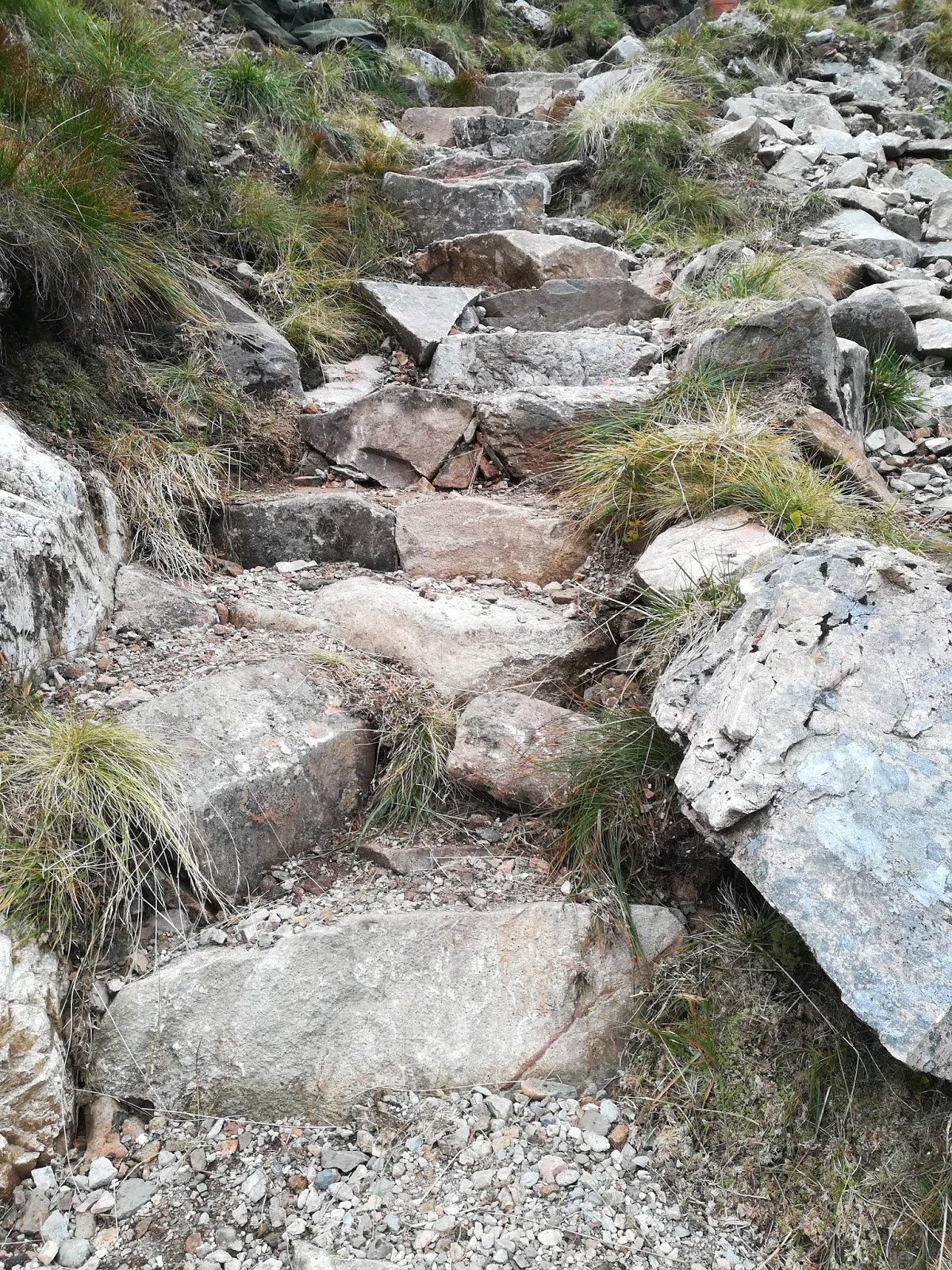
To begin with we finished off the stone pitching we had been adding onto of the bedrock to help make it a lot more accessible and easier to walk on, taking people away from the sides which are much more difficult to navigate than they look.
We then carried on the stone pitching above this slab of bedrock where the water running down the hill had produced a large, slippery gully, fitting the stones in between the bedrock and tufts of vegetation that was left.
Here a lot more work was needed than we had initially thought, including a revetment, but thankfully we were able to find the amount of stones we actually needed to complete the work.
As a rule of thumb you always need a lot more stones (and I mean A LOT more) than you might think for stone pitching.
Due to the amount and speed of the water that flows down this section we decided to add a double water bar at the top of the stone pitching to help move as much of this as possible off path. Later my work colleague added a very large ditch to help catch an amazingly large amount of water from the side of the hill and channel it through this water bar into the gully below.
And then there was more stone pitching to a section that was also just another deep, slippery gully. This took us over the last bit of bedrock we were needing to work on and onto the much flatter final section. It's interesting watching people now walk over this section of path. Before it was more of a scramble, with people often having to use their hands to help get up over the top. Now they walk up with relative ease, though the path is still pretty steep and unfortunately we can't really do anything about that.
Once the bedrock section was finished, including packing, landscaping, and adding surfacing, we moved onto the last upper section of the path. A couple of step rises were added just below a water bar that was already there from previous work to help hold the surfacing in place and then we needed to work on this original bar.
The ditching on either side had become overgrown and was no longer properly channelling water both to and from the bar. This meant that is was just flowing back onto the path. The ditching on both sides was re-dug and made much larger, hopefully increase the amount of time before it became overgrown again, and we did get to see our handy work on a very rainy day. There's a lot of water now being caught by those ditches and not now heading down the path - always satisfying.
![]() |
| Before |
![]() |
| After |
![]() |
| After |
Then it was more step rises and stone pitching until we came to the point where the path began to disappear and people are able to make their own way to the upper paths. This was probably the most satisfying section to build as we were needing to find very specific and unusually shaped stones to fit the space we had. It's always good when they all fit together, like they were meant to be, and look like a natural part of the rocks surrounding them. Many probably won't even realise that these stones have been added.
Finally we added a revetment with a large end stone to help navigate the water off this section of path and into a gully which led to the original water bar we had already been working on.
And then we started heading back down the path, carrying out final bits of landscaping and tidying as we went. I also added what is probably the worst made cairn ever (note to self - definitely need practise on this) to help navigate people up the bedrock at one of the easiest routes. Thankfully a work colleague redid the cairn and it's now much better - the photo is of my one so I wouldn't judge it on that.
Back down the path we are back at one of the previous scree sites which has already been showing signs of damage from the sheer amount of water we've had falling here recently. The large amount of rain had led to channels forming on the path, removing surfacing from some of the step rises we had placed and increasing the size of the gully in the path just down from this area.
The first thing we did was move some more larger stones down to the path to hold back more of the scree on the hill side which was being washed onto the path.
Then a double water bar was added just above the previously built step rises, made relatively deep to catch the amount of water travelling at this point.
Finally, now that we had channelled most of the water off the path, we added some step rises to the section just below the scree site where the gully was forming. This was to raise the path again and to help hold the surfacing in place, reducing any future erosion.
Because this gully had also begun to undermine a revetment previously built on the hill side we also had to add another row of stones below the previous ground level section to hold it all in place. As with all of the built features, this section needed to be packed, landscaped and surfacing added.
Not a bad months worth of work when you add in the fact that we had quite a few days of high winds and heavy rain battering against us. A couple of times the wind has been so strong it's made it difficult just to stand up let alone get some actual work done. But then it wouldn't be Scotland, and certainly not Glencoe, if you didn't get some really bad weather followed by some glorious periods of warm sun which you enjoy, suspicious of what's coming next.
Sunday, 25 August 2019
Podcasts I'm Listening To - Learning Whilst Moving
At the moment my work means that I am do two long drives (around 3 hours each) a week in areas where radio reception is very poor at best. Whilst I have been using some of this time to listen to the CDs I have left to decide whether or not I really want to keep them, it also seemed like a perfect time to do a little bit more learning by listening to some podcasts. These are the ones I've found so far and listen to on a regular basis.
- No Such Thing As A Fish - produced and presented by the QI Elves, this is a weekly podcast where they each bring up their favourite fact for that week. As you can imagine, it's very educational but it's also very, very funny and I often find myself laughing out loud as I drive - something that's probably very disconcerting to other drivers around me. The thing I love most about this show is that they talk about things I wouldn't normal think to look up and so I learn so much more than I would just left to my own devises.
- The Ground Up Show - this is one of the first podcasts that I actually started listening to on a regular basis and is produced and presented by Matt D'Avella (who I also watch on YouTube). Here Matt talks to different creators about the processes they use and what they've learnt along the way. It's obviously not as facts based as No Such Thing As A Fish and not every podcast feels like it's necessarily relavent to me. However, I've still learnt things from each show, even when I wasn't expecting to, and I like the relaxed feel of Matt and his guest talking. It's particularly interesting to learn about how each individual overcome something they were going through to get to where they are today - a nice little reminder that not everyone always has it together all the time.
- Science Vs - is another facts based podcast and will also have you unexpectedly laughing at topics. This is a Gimlet podcast and it takes all the trends and opinions that are out there at the moment and breaks them down using facts. The subjects can be very varied from week to week and can be quite hard hitting. And, again, I like the fact that I'll be listening about subjects I wouldn't normally choose to look up myself. I'm finding handing this decision to someone else a very useful tool. Probably my favourite one so far has been about Sharks and the completely misguided information that has been put out about them. Like the idea they can smell a drop of blood in a swimming pool - not actually true apparently.
- Nature's Voice - this is the RSPB's podcast. Produced on a monthly basis I've found it a pretty good way of getting the latest information about current, mostly bird but also other wildlife news. They also have little features and interviews with people working in the field and, whilst most of the ones I've listened to so far have been UK based, this is information about projects going on further afield as well. It is quite a dry podcast, but I don't mind that.
- Pulse of the Planet - this is a really lovely little podcast, and I say little because each show is only 2 minutes long. Produced daily, you get a sound portrait of Planet Earth covering the rhymes of nature, culture, and science. The subjects vary greatly and you can find yourself listening to serenading moths one day and a Texas rodeo the next.
- Normal To Nomad - is a pretty new podcast (they first uploaded on the 16th July 2019) and is produced and presented by Elsa Rhae and Barron Link. I actually found these guys on YouTube as well where they've been documenting their life in the US living in a Scamp with their dog Kamp. They only have five shows up at the moment, but it looks like they'll be posting on a weekly basis so this'll add up quickly. There is lots of information on their channel about living this type of lifestyle, but I love how specific these podcasts are, honing in on one specific subject. It works well with the more varied subjects they cover on their YouTube videos. I'm glad they've started podcasting.
There are some new podcasts that I've started listening to and am enjoying so far but can't really give a proper review about. They are:
- Sustainable World Radio - Ecology and Permaculture Podcast - I've only listened to one episode of this, which was an interview with Dr Monica Gagliano about her research into plant cognition, but it was interesting and not a subject I would necessarily have picked so I'm keen to listen to more.
- Warming Signs - this podcast looks at the most pressing environmental issues of the moment, interviewing experts and using facts to look at what's really going on. One of the shortest podcasts on this list, I've found this a really good, unbiased way of learning a little bit more about the subjects I'm interested in.
- Sustainababble - I've only listened to two episodes of this podcast and already I love it. Very funny, but full of facts and information, this is a weekly podcast that looks at a variety of environmental issues and exposing what they call 'eco-guffs'. Definitely worth a listen and I'm looking forward to the next one.
Sunday, 18 August 2019
What Good Can I Do?
When talking to people about some of the issues we face today the most common reason I hear from people to do nothing at all is 'What good can I do? I'm just one person and my contribution will be so small it won't make a difference'. And whilst there are some people who use this as just an excuse to do nothing, there are those who are genuinely overwhelmed by the issues we face today. This has been coined eco-anxiety when it comes to making the decisions on what the best actions to do for climate change are.
The general idea is that one action carried out by one person will be engulfed by the overall inaction of everyone else. In which case, why waste the effort at all. But I don't entirely agree with this idea and here's my reasoning why.
- The effect of your behaviour and actions on their own could be small, but if they inspire others to follow the same then the knock on effect can actually be quite large. Just look at Greta Thunberg and the climate strikes she has inspired across the world. While there is the unfortunate possibility that these strikes will have little affect on changing Government policies, they will inspire people to change aspects of their behaviour that, collectively, will have a larger impact. I've also noticed this in my life and the choice I've made to become an almost (work in progress) dairy-free vegetarian. I'm not militant about it nor do I try and push it onto others, but people naturally have questions and they especially have questions when it comes to the very physical job I manage to do without meat (apparently the one thing you need to by physical). When they find out that I'm healthy and happy, that I have no problem doing the work I do, and how easy and tasty the dishes that I make are they want to try it too. They don't necessarily go completely vegetarian, but they do end up adding vegetarian dishes to their meals and cutting back on the amount of meat they eat, which environmentally still makes a difference.
- You may not be able to act directly for a cause or action you believe in, but you can support those who are. Most of us in the western world are in a fortunate position to be able to make a financial donation to one or more of the variety of charities available to us. Whilst on our own we wouldn't be able to make provide the necessary funds to make a difference, our smaller individual donations are all part of supporting the work they do and without it the organisations wouldn't be able to function at all. It's a little contribution to us, but it makes a big difference to someone else.
- If we've learnt nothing else from Brexit (though lets face it, there's a lot to learn from Brexit) the one thing we have learnt is what a difference a vote can make. Studies that came out after the voting took place showed that around 35% of Britains didn't actually vote and, if everyone had voted, then the likely results would have been 50.35% in favour of remaining (https://ukandeu.ac.uk/what-if-everyone-had-voted-in-the-eu-referendum/). Obviously this is not conclusive, if it had happened that way then the last 3 years would have been very different. Today, especially with the types of politicans we have at the moment, we often think that voting is really a bit pointless and won't produce any positive changes to the way our lives are. But Brexit has clearly shown each vote really did make a difference, and not necessarily for the better.
- Recently I've been coming across a lot of articles about how being kind to people has a positive impact on the giver, which would make it a worthwhile action in its own right (my favourite article on this comes from the Random Acts of Kindness website). But as a way of making a positive change in the world it's actually been shown to be quite effective. Those who have acts of kindness shown to them are much more likely to then act kindly themselves in their behaviour and decision making. Not only does this have a cascading affect, as in the person you are nice to are more likely to be nice to multiple people who will themselves be nice to multiple people (as shown here), but people will also be kinder even if they don't actually receive the act themselves but see it happening to someone else. In otherwords, acts of kindness are contagious. So, that one little act you might think is insignificant and impactless can actually have a very large affect on the world around you.
When you think about everything that is wrong in the world and all the things you would need to do to fix them completely it can be very overwhelming. It may even make you not want to try at all. But even just little behaviours and actions can make a difference. And, even if it turns out that my actions don't have as a big a impact as I would hope, I'd still rather know that I had actually tried than have done nothing at all.
Sunday, 11 August 2019
Dry Stone Walling Training
![]() |
| Taken from https://pixabay.com/images/search/dry%20stone%20walls/ |
And because I always talk about the weather when it comes to work I thought I'd start with that 😉. It had forecast rain for that weekend, but, apart from a downpour on Saturday morning, we got blisteringly hot sun and I managed to really work on increasing my farmers tan whilst squeaking around in my wellies. The two trainers were Jim, who has been building dry stone walls for decades after retiring as a vet, and Martin, who had been on an apprenticeship with CSDSWA a couple of years ago and was now a fall time dry stone waller.
We were each given a metre to work on and which we would take responsibility for. The previous wall that had needed repairs had already been mostly dismantled so we could re-use the stone and the first stage we had to do was to remove a section of grass and ensure the ground we were building on was flat. Starting with the larger stones we started with the foundation stones, in which we really needed to ensure was flat, and then built up the base with stones reducing in size until we were half way up the height. Then we placed cross stones on the wall for stability before building the second lift before adding on the final layer of stones, the cope stones. A batter frame and string was used to ensure we got the right shape of the wall as we moved higher up the frame.
We had to ensure that the lines were as straight and close to the guide string as we could manage, and that the main building stones went at least a third of the way into the wall. Any space in the centre was filled with smaller stones, acting as packing to ensure the wall remained strong, and placed between the stones to keep them flat in placement. We followed advise like 'long is strong' and 'turn, turn, turn' when placing the stone into the wall. We also had to ensure that the next layer of stones covered the joints between the stones of the previous, also to add strength. There were a few tools and buckets we learnt to use during the training, but the main tool was the waller's or stone hammer. This allowed us to alternate between breaking up the stone with the flat end, angled when you hit it (a new techniue I will definitely be taking with me), and to chisel at the stone with the angled side.
I was actually quite satisfied with the work that I did (though I managed to somehow delete the photo of my finished work, grrr), but I can definitely see where I can make some significant improvements if I were to build another wall. There are some similarities between dry stone walling and the stone work I do in path building, especially when it came to the importance of packing the stones to ensure the strength of the structure, but the stones used are obviously much smaller and the placing of the stones much more delicate and precise. I definitely had resist the urge to drop the stones rather than delicately place them on the wall, a mistake I made once and the noise it made brought me right back to what I was supposed to be doing. Thankfully it didn't do any damage to the wall.
It was a very interesting way to spend the two days of my weekend, though it probably didn't give my body the rest I should have given it from work, and I really enjoyed learning about dry stone walling. It has definitely given me some extra skills which I will be taking to work with me, but if I was to decide to do this as an additional job I would need to gain some extra qualifications and more hours in walling before I could start applying for work with different organisations. They were also good enough to give us a book published by the organisation about dry stone walling and which covered the skills they had taught us over the weekend. I'm definitely glad I signed up for this training course.
Subscribe to:
Posts (Atom)